

Download Apk of Free Apk ?The Nut Job (The Official App) v1.0 from here
Job ( App) v1.0 Android Market App : 2.2+ Android Market App : Join Surly adventure lifetime when nature gets him kicked out park city. He then becomes hero when he spots Maury’s Nut Shop just get ready.
Here is updated download link
Free Apk ?The Nut Job (The Official App) v1.0
Showing posts with label the. Show all posts
Showing posts with label the. Show all posts
The Nut Job The Official App v1 0
Sunday, December 18, 2016

Deus Ex The Fall v0 0 19
Wednesday, November 23, 2016
Download Apk of Free Apk ?Deus Ex: The Fall v0.0.19 from here
Deus Ex: v0.0.19 Android Market App : 3.2+ Android Market App : Deus Ex: start new journey award winning Deus Ex. Set– era, technology augmentation
Here is updated download link
Free Apk ?Deus Ex: The Fall v0.0.19
Still No Formal Word On The Win10 Fall Upgrade
Monday, November 14, 2016

By Tracey Capen
When Windows 10 was first released back at the end of July, the recommendation was to wait for the first major update before migrating to the new OS. That big fix for Win10 is due out any day now.
Plus: Google puts another nail in the Windows XP coffin — and adds another one for Vista, too.
Still waiting for Windows 10 Fall Update
As has been widely reported, the much-anticipated, next major Win10 update, Version 1511, is due out this month. Some reports claim that its essentially Insider build 10586, which went to the fast ring Nov. 5 and then to the slow ring Nov. 9. As a reminder, fast-ring releases are generally quite stable but could have some significant bugs; slow-ring releases are close to a finished product.
There have also been numerous speculations/predictions that it would be released on the regular monthly Patch Tuesday. But based on the updates offered this Patch Tuesday, the Fall Update is still a no-show. Still, the past few months, Microsoft has been much more loosie-goosie about its Windows and Office update schedule. The current betting is that it will start rolling out this Thursday, Nov. 12.
The update could arrive any day now, and it should be chunky. Win10 users should prepare for a relatively long download-and-install process.
Time for XP and Vista users to dump Chrome
A Nov. 10 Google Chrome Blog post notes that Google will no longer send out updates and security fixes for Chrome on XP and Vista. But theres no need to panic; the new policy reportedly starts in April, 2016. Dropping support for Vista is a bit puzzling; Microsoft will send out security updates until April 11, 2017. Mark your calendars.
(The new Chrome policy isnt restricted to Windows; Apple OS X 10.8 (Mountain Lion) and earlier versions will also no longer get Chrome updates.)
The post notes that Chrome will continue to work on those platforms. But if theres any single app category that you want to keep updated, its your browsers.
Finally, Google Maps while offline
Smartphones have become the go-to devices for searching locations and viewing maps. But when your connection to the Internet gets spotty, digital navigation can also get dicey. Its the primary reason I use a standalone GPS unit in my truck.
Now, however, not only can you run Google Maps to your mobile device, you can download geographic data for use offline. That includes, according to the Google announcement, turn-by-turn directions and points of interest. Apparently, the app will automatically switch between online and offline modes, based on its ability to connect to the Net.
Not surprisingly, the new Google Maps is available only for Android devices; an iOS version is "coming soon."
Audible vs. Kindle Unlimited; pros and cons
I dont have much time to sit and read books, but Ive been an Audible.com subscribers since its inception. Currently, I pay $14.95 for one book a month, and I listen to Sci-Fi, history, and mysteries while walking the dogs and doing other stuff that doesnt require much thought. Ive especially enjoyed audio books during long road trips up and down the Left Coast.
I also have a Kindle account for times when I can sit and read. So my interest was piqued when I received a Kindle Unlimited offer for just $10 a month (with a 30-day free trial). The $10 fee doesnt restrict you to one or two books a month — its effectively unlimited. Whats especially intriguing is that the digital book Im reading lets me switch back and forth between reading and listening modes.
So it seems as if Kindle Unlimited might be a better deal than Audible (which is owned by Amazon). But the proof of the pudding is, as they say, in the eating — the two services are different. You effectively purchase an Audible book. If you cancel your Audible membership, you still have access to all the books youve paid for. Whether thats a plus depends on whether you reread books.
Kindle, on the other hand, is more like a library — you borrow books. When you cancel your Kindle membership, you lose access to any books youve selected.
But its a bit more complicated than that. A Kindle Unlimited account includes access to a limited selection of Audible books. How many is hard to say, but the Amazon site lists over 4,500 books with narration. (It also list over a million books in the Kindle Unlimited library.) Oddly, the Audible site states that you can pick from over 60,000 Kindle books with the audio option. And Audible has a catalog of over 180,000 titles, including books, magazines, and other content.
So which is better? That, of course, depends on your reading habits. It youre like me and have little time for actual reading, Audible is probably the better way to go. If you have more time on your hands and are less picky about what you read, Kindle Unlimited looks like a good deal.
Why The US Has Slow And Costly Internet
Saturday, August 27, 2016
Why is the Internet slow and costly in the U.S.?
By Patrick Marshall
In Tokyo, Seoul, and Hong Kong, residents get bidirectional, gigabit Internet for less than U.S. $40 a month. On the other side of the globe, Parisians have a similar deal, though their upload speed is only 200 megabits per second (and much of the rest of France isnt so lucky).
Most of us in the U.S. would be happy with half that bandwidth — even as we accept paying twice as much as Internet subscribers in Asia and Europe. In Seattle, I pay Comcast nearly $67 per month for a 50Mbps (6.2 megabytes per second — MBps) connection.
So why is broadband such a bad deal in the U.S.? What gives?
The answer lies at the uneasy intersection of technology and politics, and the story begins in 1984, when Congress passed the Cable Communications Policy Act (more info). At the time, of course, personal computers had only recently been introduced and the public Internet didnt yet exist. (The precursor to the Internet — ARPANET [more info] — was carrying messages between university and government researchers and had been doing so since 1969.)
In those days of dial-up connections, legislators probably had no inkling that most consumer broadband Internet service would eventually travel over cable-television lines. Their primary concern was bringing some order to the burgeoning cable-TV markets, ensuring both competitive pricing (via deregulation) and standards in programming. Government had some say in the matter because the private-sector companies cables had to traverse public property. But there was a long debate over which government agencies would implement the act: federal, state, or local?
Congress cedes cable access to local control
The Cable Communications Policy Act of 1984 gave municipalities primary authority to grant and renew franchise licenses for local cable operations.
Generally, communities have given cable companies access to public property in exchange for agreements about such things as programming and access to residences and businesses in specified areas.
It also meant that cable service would vary widely from one community to another.
In some cases, cable companies were granted exclusive rights to a particular region. But even without exclusivity, the first company to reach an agreement with a community generally became the sole provider because of the high cost of laying new cables. Competitors faced the daunting task of quickly making their own agreement with a local government and then carving out enough subscribers to pay for the huge investment.
And then the cable companies got lucky. Use of the Internet exploded, and low-bandwidth messaging became high-bandwidth streaming entertainment. With customers demanding faster Internet connections, cable immediately had a clear advantage over dial-up, DSL, and other types of Internet connections — it offered both speed and broad coverage.
That gave cable companies a huge customer base they didnt have to acquire. Moreover, the cable companies werent providing content; they earned their money from the connection to the Internet, not from selling streaming entertainment to customers. That meant that the cable companies had little incentive to improve service.
Municipalities try to cash in on broadband
Frustrated by the lack of competition and the quality of service provided by cable companies, some communities opted to use their own infrastructure to provide Internet service.
In 1999, after a storm wiped out much of its communications infrastructure, the small town of Bristol, Virginia, built its own fiber-optic network for internal city government communications. In 2003, the town expanded that network to provide Internet service to the entire community. The nonprofit Optinet company formed by the city now offers broadband services to other communities in southern Virginia.
In the years since Bristol launched Optinet, more than 130 communities — mostly smaller towns not well served by cable companies — have followed suit, providing services over city-owned fiber or cable
The Island Castaway 2 FULL UNLOCKED APK DATA
Sunday, June 26, 2016
Download Apk of The Island Castaway 2 FULL UNLOCKED APK + DATA from here
The Island Castaway 2 FULL APK Unlocked TRY IT FREE, THEN UNLOCK THE FULL ADVENTURE FROM WITHIN THE GAME! ? A huge, colorful island to explore ? Over 300 intriguing quests to complete ? 16 original and engaging characters ? 28 rarities to collect for Professor Langst ? 11 unique recipes to maste...
Here is updated download link
The Island Castaway 2 FULL UNLOCKED APK + DATA
Froog and the spider tower free android 38 online game
Monday, May 9, 2016
Download Apk of Free Apk ?Froog and the spider tower free android & online game from here
Hi folks, I would like my first unity game. I spend months. work alone, I expect some feedback from fellow video game players
Here is updated download link
Free Apk ?Froog and the spider tower free android & online game
The Howler v1 0 6
Tuesday, May 3, 2016
Download Apk of Free Apk ?The Howler v1.0.6 from here
v1.0.6 Android Market App : Android 2.2 Android Market App : Vilnius, 1905.
Here is updated download link
Free Apk ?The Howler v1.0.6
Be Smart On The Internet
Wednesday, April 20, 2016

by Philemon Arpelleh Onyemenyan (Belemgbunli)
INTRODUCTION
To me, using the internet is so much more than fun, entertaining and experiencing. You may also have wondered about how the internet has gone a long way to provide so many intriguing benefits to you, myself and the rest of the human family; talking about research, exploring, connecting, just to mention but few.
There are times when you come across so many things and I mean everything springing from what you need and those you don’t, some of the worse being so abhorring. Can we, I mean you and I plus the entire ‘cyber-related’ people overlook the fact that the internet as it is can be a ‘wave of disaster’ to humanity?
I’m not alone when it comes to the fact that some internet related stuffs can be so disgusting. There are times when you are busy browsing for priceless information, then suddenly here it comes! Of course you know what I am saying? Nudity, explicit image files, pornography and the likes. The annoying stuff you don’t want to see! Then quickly you have to turn that internet page off.
It is indeed as they say, true that ‘formerly, dogs hunted for bones but these days, bones avail themselves for dogs with limited efforts of hunting or none at all’.
The Internet has also in recent times been a bridge of transport that transfers rumors to the most distant part of the world.
With social networks and Apps such as Facebook, WhatsApp and the others, listing but few, the rate of transporting false information and rumors some of which tarnishes the image of honest famous people and big companies can never be underestimated.
What about the cases of connecting with friends over the internet across countries and other borders? Connecting with friends over the internet, some of those we know little or nothing at all about them can be dangerous. Why? Some friends can be imposters and can harm us, running into our privacy and releasing a good factor of our online information.
In view of these, I made a bunch of important research to publish a document of some important ways to be smart on the internet and how to protect ourselves; you and me, plus the rest of the internet related folks.
Read the series of my publication to learn more.
PART ONE (#1) to follow…
Deus Ex The Fall v0 0 15 APK
Monday, March 21, 2016
Download Apk of Deus Ex: The Fall v0.0.15 APK from here
Deus Ex : The Fall is the start of a new journey in the award winning Deus Ex game series! Deus Ex: The Fall play.google.com.dxm Set in 2027– the golden era for science, technology and human augmentation. Ben Saxon an augmented former British SAS Mercenary , is desperate for the truth be...
Here is updated download link
Deus Ex: The Fall v0.0.15 APK
Froog and the spider tower free android online game
Saturday, March 5, 2016
Download Apk of Froog and the spider tower free android & online game from here
Hi folks, I would like my first unity game.
Here is updated download link
Froog and the spider tower free android & online game
Have you seen the worlds largest bony fish Sunfish aka Mola Mola
Sunday, February 1, 2015

Sunfish is the largest bony fish in the world as listed in the Guiness Book of Records.
The fish has the record due to its unsually HUGE body structure and size. The length of its body averages between three to five meters long! This gorgeous giant sunfish was on the Atlantic coast of the USA, it was three meters long and weighs over 1.5 tons!
Another giant Sunfish was caught in 1908 near Sydney. The length of 4.26 meter and weight 2, 235kg. Sunfish Mola Mola has a totally different look from other fishes. It body flattened to form an elongated drive a little, short tail and the finds are connected to each other. The skin is thick and lumping. During spawning season, Mola Mola lay eggs up to 300 million at a time! Sunfish is considered as a delicacy in some part of the world like Taiwan, Indonesia and Japan.


This post sponsored by:
Dr Mobiles Limited
1 Huron Street, Takapuna, North Shore 0622
Tel: (09) 551-5344 and Mob: (021) 264-0000
Web - Map - Google+ - Email - Posterous - Twitter - Blogger - Flickr - Author
The iPhone 6 less scratch resistant than the iPhone 5s
Friday, January 30, 2015
Towards a new Applegate? A protest is open thread on Apples support forums, this time of the alleged problems of scratches, a number of users complaining that their iPhone 6 scratches more easily than the previous model, even when the device is placed in an "at risk" environment.
The thread already has over 600 responses and generated nearly 103,000 views, high enough numbers so that we can point the finger of a possible screen design concern or a fault affecting a number of units for production.
The screen of the iPhone 6 is not identical to that of the iPhone 5s, both in terms of the overall shape (curved at the edges, standing more frankly of the case), but also in materials used, Apple has opted for an Ion-X layer, supposedly more resistant to scratches precisely, but the new mode of production and the needs of mass production could generate a rate of "defects" higher than the usual.
Apple has also removed its last layer screens the thermoplastic / reinforced polymer present on the iPhone 5s (Ion-X would be enough to replace). Despite the growing number of complaints, we note nevertheless that almost as large number of reactions in the forums indicate reverse finding or a screen rather highly resistant to scratches and small impacts. We must remember that the iPhone 5s had had its share of devices suffering from minor defects due to manufacturing problems (not design), defects baptized then "ScuffGate" and were characterized by scratches on the hull . A few weeks later, the problem was solved ...
Users involved, mostly reported that Apple made no difficulty replacement shop, which still seems rather point to a problem affecting a precise series of devices.
Read More..
The thread already has over 600 responses and generated nearly 103,000 views, high enough numbers so that we can point the finger of a possible screen design concern or a fault affecting a number of units for production.
 |
| iPhone 6 scratch |
Apple has also removed its last layer screens the thermoplastic / reinforced polymer present on the iPhone 5s (Ion-X would be enough to replace). Despite the growing number of complaints, we note nevertheless that almost as large number of reactions in the forums indicate reverse finding or a screen rather highly resistant to scratches and small impacts. We must remember that the iPhone 5s had had its share of devices suffering from minor defects due to manufacturing problems (not design), defects baptized then "ScuffGate" and were characterized by scratches on the hull . A few weeks later, the problem was solved ...
Users involved, mostly reported that Apple made no difficulty replacement shop, which still seems rather point to a problem affecting a precise series of devices.
The worst thing to happen to your Apple iPhone 4S liquid or water damage repair iOS rescue help insurance claims Auckland
The following article forwarded to me by an Apple iPhone 4S user, it was the result of his research concerning iPhone 4S liquid damage repair and tips. He had accidentally wet his spanking Apple iPhone 4S not so long ago. See what he has to say....

I didn’t think it would ever happen to me, as I’m always ultra-careful, although it seemed to happen to my teenage son every few months. One time he dropped his phone in his bowl of cereal, and another time it was in the kitchen sink. The inevitable finally happened to me one day when I was out with friends and my purse got knocked off the sink in the restroom, flipped over, and my iPhone slipped out of the pocket it was in and literally jumped into the toilet.
The iPhone had been completely submerged, so I knew it was water-damaged. It worked at first, then turned off, and I could literally see the water inside it. I knew it was cashed. I was camping, so didn’t have anything with me to try the tried-and-true methods of preventing water damage. The next morning it was still wet inside and while it turned on and off, the touchpad didn’t work at all, and neither did the Home button. It was because of all this that I learned what to do when your iPhone gets water damage.Apple-Care program Doesn’t Work
Apple does not cover water damage in either their one-year warranty or their Apple-Care program. They want to make sure they aren’t covering that either, so have placed sensors on the phone to detect water damage. There is one inside the headphone port, another in the charger connector on the bottom, and a few more hidden inside as well. The sensors will turn half pink/half white with water damage. Some people have been known to put tiny little pieces of white paper over the sensors to cover the ones on the outside, but there isn’t anything you can do to hide the two internal ones.
![]() Solutions
Solutions
The first thing you need to do is turn the iPhone off and disconnect it from any possible power sources. The next step is to place it in an airtight Ziploc bag with silica gel packets if not uncooked rice. You should immediately start searching for a proper or reuptable repair centre to inspect your water/liquid damage iPhone 4S. Remember, the longer you wait to get it repair, the worse it will get -- as fungus will grow, corrosion start damaging the internal part of your Apple iPhone 4S. There will be physical change start to take place as moisture will warp or alter the shape of your main circuitboard or motherboard.
 Professional Repair Centre
Search the internet for a reputable or indepent repair centre who will help you out. Please note that the real-pro will not charge you outrages inspection fee ($45 up to $85, non-refundable) at all as they not rip off people for heftpy or unrealistic "inspection fee". You should conduct indepth research about water damage repair centre, on google, facebook about any possible reliable centre in your area. Water damage Apple iPhone 4S usually have 50/50 chance of being repair.
Be careful of those semi-pro who do not have any office phone line or those that do not have a real physical address
The Last Draw
If you liquid damaged iPhone 4S cannot be repair, you can file for a lost through your home content insurance. Take note on the excess fee that you have to pay the insurance company before filing for a claim.Any decent repair centre will not ask your an insurance damage report (some dubious operator charge you up to $85 per report). The reason being that professional repair centre earn profits via professional repair job awarded to them from insurance company. So the more free inspection they do, the more business they will get from those big insurance company. This post sponsored by: Dr Mobiles Limited
1 Huron Street, Takapuna, North Shore 0622
Tel: (09) 551-5344 and Mob: (021) 264-0000
Web - Map - Google+ - Email - Posterous - Twitter - Blogger - Flickr - Auhtor
2012 Tech Report The latest Samsung Galaxy S3 Features!
Thursday, January 29, 2015

The Samsung Galaxy S3 features innovative new technology to see if youre looking at it and keep the screen on if you are. Heres a brief look at the years most hotly anticipated phone.
4.8” Amoled HD screen
The S3’s enormous screen feels big in the hand, although the device is just 16 per cent larger than its predecessor, the 20 million selling S2.
Smart Stay
The phone tracks your eyes, so as long as you’re looking at it, the display won’t dim or turn off.
Direct Call
If you’ve got a contact on your screen, there’s no need to hit call: simply hold the device up to your face and the number will be dialled automatically.
Smart Alert
Samsung’s enhanced notifications centre tells you what’s happened since you last looked at your phone in order of importance.
Burst shot and best photo
The 8MP camera now offers a 20-shot burst mode and will choose the best photo for you. Photos now possible at the same time as video filming.
Face Zoom and Slide Show
Double tap a face to zoom in; automatic slide show generation zooms in on faces as individual pictures for pictures with lots of people
Social network and camera integration
Automatic tagging of pictures, and the option to send images directly to those identified in them, called Buddy Photo Share, or display social media profile information on screen. Group Tag lets you tag multiple people in one go, if you set up a group first.
Dropbox storage
50GB of free Dropbox storage for two years.
S-Voice
That’s S for Samsung, not Siri. This feature allows you to control your phone through voice, eg to turn up the volume, and to ask it questions.
S-Beam
High speed file transfer via NFC and WiFi Direct, between two phones touched together, operating at up to 300Mbps.
Pop Up Play
Play video in a window on any homescreen.
All Share Play and Cast
Share your S3’s screen to a TV, or use the screen as a remote control.
Specifications:
Screen:
4.8” Super Amoled HD display
Storage:
16/32/64GB depending on model, plus expandable MicroSD card
Cloud storage:
50GB Dropbox for two years
Colour:
Pebble blue or marble white
Battery:
2,100mAh (wireless charging optional extra)
Camera:
8MP rear; 1.9 MP front
Resolution:
720 x 1280 px (306ppi)
RAM:
1GB
Dimensions:
136.6 x 70.6 x 8.55 mm
Weight:
133g
Operating System:
Android 4.0.4
Processor:
Exynos 4 Quad (1.4GHz)
This post sponsored by:Dr Mobiles Limited
1 Huron Street, Takapuna, North Shore 0622
Tel: (09) 551-5344 and Mob: (021) 264-0000
Web - Map - Google+ - Email - Posterous - Tumblr - Twitter - Blogger - Flickr - Author
Foxconn says iPhone 5 is the most difficult device it has ever built Dr Mobiles Limited Auckland New Zealand
Wednesday, January 28, 2015

Still can’t get an iPhone 5? It might be Apple’s (AAPL) fault and not just a display production shortage. According to The Wall Street Journal, a Foxconn official who wished to remain anonymous said the “iPhone 5 is the most difficult device that Foxconn has ever assembled” and even now, workers are still learning how to manufacture the smartphones to meet Apple’s high standards.
The anonymous Foxconn official went on to say that the iPhone 5 “uses a new coating material that makes it more susceptible to scratching” and that it is much more difficult to meet quality checks. Since the iPhone 5 launched last month, Apple has caught flak for shipping smartphones with scuffs and scratches on the devices.
“It’s always hard to satisfy both aesthetic needs and practical needs,” said the Foxconn official.
Foxconn made headlines again on Tuesday after it reported that it had discovered underage interns working at its Yantai facility in the Shandong Province in China.
This post is sponsored by:
Dr Mobiles Limited (Map)
1, Huron Street, Takapuna, Auckland 0622
Tel: (09) 551-5344, Mob: (021) 264-0000
info(a)drmobiles.co.nz
Facebook - Blogger - Twitter - Tumblr - Google+
New Lynn Branch (Map):
3069, Great North Road, New Lynn, 0622
Tel: (09) 5555-344, Mob: (021) 374-007
sales(a)drmobiles.co.nz
Forget iPhone 5 The iPhone 6 Is Coming New Apple Patent Features Flexible Displays Tactile Feedback
Tuesday, January 27, 2015
It’s only been a week since Apple released the iPhone 5 to its adoring public, but gearheads are already looking forward to what new technologies and features the Cupertino, Calif.-based computer company might unveil in next year’s smartphone model, presumably called “iPhone 6.”
A newly released patent, filed in March but published on Thursday, describes a handful of new technologies currently being cooked up in Apple’s research & development labs for new iDevices, including tactile keyboards, laser microphones and speakers, and flexible displays.
All of these new features would reportedly work in tandem to give users a dynamic iPhone experience that conforms to the user’s needs: Flexible displays allow for easier holding and typing, while the highly-advanced tactile screen would create buttons when needed so the user can feel the letters as they type, or touch the topography on an Apple map.
Wireless technology blog Unwired View had a chance to break down some of the elements in Apple’s newly published patent application, and described how the tactile display would work:
“By placing an array of piezoelectric actuators below the display and activating them on demand for tactile feedback… this way you have a perfectly smooth surface when you browse the net or read your email," wrote Unwired Views Stasys Bielinis. "Call up a keyboard, [and] actuators pop up and now you can feel the letters as you type."
Tactile display technology, which is useful for using your device without looking at it, has been something Apple has long been interested in: On May 7, Apple published a patent for advanced haptics using a flexible OLED screen, which would allow users to physically interact with their content by touching it – an experience accomplished with sensors and actuators working simultaneously.
Apples multi-tiered system is extremely sophisticated: Using several layers of elastic screens stacked on top of each other, Apples screen can produce 3D buttons or objects to interact with, as well as give texture to images, like topographical maps, but only when theyre needed. This technology is currently being explored by another company, Tactus Technology, which created a video to explain how it all works.
Similar to Tactus work, Apples haptic system can respond to and create different types of actions, including vibration, net displacement, bending, deforming, or any combination of those elements. The technology can also work with a secondary display screen or audio system, which would be useful if Apple ever builds its iTV, but the system can also be applied to flexible organic light emitting diode, or OLED, screens. This advanced haptics system would also work with almost every portable Apple device, including iPhones, iPod Touch devices, iPads, MacBooks, and even TVs, video projectors and e-Ink displays.
But one of the great features about this flexible display technology is its ability to contain other internal components between the layers of the screen, such as a laser microphone or pressure sensor that, according to the patent filing, “receives sound or pressure information through the flexible display,” which can be temporarily or permanently deformed to provide tactile feedback to the device’s owner.
Unwired View also points out that since the display would be flexible, it could dynamically react to different sound vibrations as you speak, so Apple could potentially remove the traditional microphone holes and implant the sound technology within the screen to capture those sound vibrations.
In addition to sensing sound vibrations, the flexible screen would also be able to house components to generate sound waves as well. With a simple transducer behind the screen to transform electric current into vibrations, as long as the structure gets some barrier support, part of the screen can become a speaker membrane for surround sound. In other words, Apple could potentially implant different display based speakers for woofers, subwoofers, tweeters, supertweeters and mid-range speakers all right into that flexible screen.

While flexible screens, advanced haptics and microphone and speaker systems built directly into the display, whatever iDevice these technologies are intended for – hopefully next year’s iPhone 6 – looks to be a real powerhouse of new and exciting software technology.
However, these are just a few of the features we’re expecting in the iPhone 6, the seventh-generation smartphone expected to launch in Q3 or Q4 next year. There were a number of software features we were expecting for this year’s iPhone 5, but didn’t make into the final design; however, based off the multitude of rumors and patent filings about these technologies, it’s completely possible that these will be future features in an upcoming Apple device. Here’s what we’re looking forward to:
Crack-Proof Glass: Everyone whos ever had a rough Saturday night would certainly love this patent. Granted on Nov. 15, Apples patent for crack-resistant glass uses the same alumino silicate glass solution used in the iPhone 4 and 4S, but chemically treats it with potassium and sodium ions to achieve greater compression thresholds on the surface and edges of the glass, making it less susceptible to cracks.
Apples patent also includes a handy feature that would appeal to everyone whos ever dropped their iPhone on a Saturday night: The patent calls for a shock mount to be placed between the glass and the body of the device, which will instantly inflate if the device senses its falling. If the iPhones internal accelerometer senses its falling, an actuator within the device sucks in the cover glass as it accelerates to the ground, protecting it from damage.
NFC: The big kahuna of features, the near-field communication (NFC) chip which was long-rumored to be in the iPhone 5 until the final weeks leading up to the event, in which teardowns of new iPhone prototypes found no such chip. However, we were really hoping itd be there for so many reasons.
NFC is nothing new -- in fact, many current smartphones have the chip built-in so owners can use mobile payments solutions such as Square and Google Pay -- but Apple had a chance to implant and popularize the technology in a landmark device. A slew of recently granted patents seemed to suggest that Apple would introduce the NFC chip in the near future, but it just was not meant to be in the iPhone 5.
iWallet: Apple won a major patent on March 6 for a piece of technology called the "iWallet," which is a digital system that gives users complete control over their subsidiary financial accounts on their iPhones, and also leverages Near-Field Communication technology to complete credit card transactions directly on the phone as well. The iWallet has many different features, including giving users the ability to see their entire credit card profiles, view statements and messages from their banks, and even set parental controls for their children, should they also want to use their iPhones as digital wallets. Outside of the iPhone, users can keep track of their payments and statements within the iTunes billing system, which keeps credit card information and records safe and secure. Theres a possibility that iWallet could also work with other Apple utilities, which could allow users to buy things like movie tickets directly within the apps, but only time will tell with that one.
iTunes Gifts: Another Apple patent unveiled in April described a system for standardized buying, sending, and receiving of media files from a media provider (iTunes) between multiple devices (iPhones, iPads, and iPod Touchs). The process was simply called, "Gifting," and it would certainly work with an NFC-capable iPhone.
Downloading and storing digital media with online service providers has become commonplace -- more so than purchasing DVDs and CDs at physical stores -- but its not very easy to transfer digital files from one individual to another, usually because of copyright laws. Apple believes "Gifting" is the solution.
One method for gifting requires the sender to authorize a gift charge to their iTunes account, which is then transmitted from the senders device to the receivers device -- via tapping, or as long as theyre nearby -- thanks to the NFC chip. If the recipient of the gift isnt nearby -- or you want it to be a surprise -- the gift-giver may submit an official request with iTunes, which then processes the request and charges the initiators account for the given file. The patent also allows for multiple gifts to be sent in a single transaction, as well as certain customization options for the gifts -- including voice greetings and custom gift images, likely to conceal the gifts identity before the recipient opens it.
Audio Sharing Network: The last few months have seen Apple pay increasing attention to audio. It spun off its Podcast application as a completely separate application from the "iPod" app, it released its new EarPods with a superior speaker system, and now, according to a newly-filed patent for the iPhone, Apple plans to make the iPhone into a "conference telephone," designed to cut out the background noise while recording audio, which can then be packaged and distributed. This feature would certainly appeal to students that want to record their lectures, as well as enterprise professionals that want to hold and record teleconferences with multiple individuals and be able to hear everyone clearly.
The Shopping Companion: In 2010, Apple was granted a patent for an NFC-enabled application called "Products +," which packages and tags merchandise or products sold by vendors to learn more information about the product itself, as well as win "hidden benefits" like free merchandise or free music, or any kind of reward for that matter.
"The iPhones camera may be used to obtain a digital image of a matrix barcode tag," Patently Apple said. "The iPhone may thereafter employ optical character recognition (OCR) software, barcode-reading software, or matrix-code-reading software to extract information from an image as discussed later in the report."
For example, if a vendor like Starbucks or Tim Hortons used a barcode on the outside of their paper cups, iPhone users could scan the tags with their NFC-enabled iPhones and read nutrition information, advertisements related for related products, or ways to win free music or discounted food or drinks. The NFC chip could even be used to identify the song playing in the restaurant so you can purchase it. Read more about the incredible ways NFC could benefit the shopping experience here.
3D Photography. Its possible the iPhone 5 could allow users to finally snap 3D images with their phones. While existing 3D cameras and video recorders gather three-dimensional information from objects, theyre generally incapable of getting detailed enough information in relation to the shapes, surfaces and depth of the objects. Apples patented solution involves a series of systems, tools and methods to capture a 3D image by using multiple sensors and cameras. One sensor would capture a polarizing image, while two other sensors would capture two different non-polarizing images, and Apples system would combine the images into a composite.
The Photographers Timer. Traditionally, self-timing cameras are used to take pictures of a big group, or a self-portrait. But in Apples self-timer, a patent granted March 8, the iDevices camera can identify the photographer and ask if they want to be in the picture. At that point, the iPhone will simply wait until it detects the photographers face in the viewfinder before it automatically snaps a photo. If you are the "photographer" who also wants to be in the picture, the iPhone will simply wait until it detects your face to take the picture.
"But what about interruptions? What happens if I get a call after I set the self-timer?" Wonder no more. If you set the timer and then your phone goes off, the timer will still wait until it has detected, recognized and verified that you are the photographer and that youre in place for the photo. Now if only Apple patented a tripod ...
Apple Avatars. If you want to buy movies, apps, or any content through Apples iTunes Store or App Store, Apple requires you have an Apple ID. Your Apple ID sticks with you in the companys Game Center, which keeps track of a users achievements across purchased and downloaded games. But if this recently-granted patent has any bearing on the immediate future, Apple users may soon get to make customizable Apple Avatars, which users would use to represent themselves within potential online or gaming environments. Apple users could create a 3D model of themselves, customizing features like hair, eyes, nose, and eyebrows, as well as other features and accessories. While avatars seem to be geared towards kids, it would actually help give users a source of identity while making the Apple brand -- and identification procedures -- a little more fun. Dont be surprised if Apple had Pixars help on this one: Just look at the eyes.
3D Object Recognition. On May 10, the U.S. Patent and Trademark Office published a series of Apple patentsrelating to 3D face and object recognition technology. Apples system involves taking a picture -- either with a front or rear camera -- and the 3D recognition software would distinguish between the two-dimensional projection of the image and the three-dimensional shape of the objects in the image. The process would be fully automatic, which would help for identifying faces in a group of objects, or even identifying objects in X-ray images.
Which of these features are you most excited for? Would you trade in your iPhone 4, 4S, or 5 for a phone with some or all of these exciting features? Let us know in the comments section below.
This post is sponsored by:
Dr Mobiles Limited (Map)
1, Huron Street, Takapuna, Auckland 0622
Tel: (09) 551-5344, Mob: (021) 264-0000
info(a)drmobiles.co.nz
Facebook - Blogger - Twitter - Tumblr - Google+
1, Huron Street, Takapuna, Auckland 0622
Tel: (09) 551-5344, Mob: (021) 264-0000
info(a)drmobiles.co.nz
Facebook - Blogger - Twitter - Tumblr - Google+
New Lynn Branch (Map):
3069, Great North Road, New Lynn, 0622
Tel: (09) 5555-344, Mob: (021) 374-007sales(a)drmobiles.co.nz
3069, Great North Road, New Lynn, 0622
Tel: (09) 5555-344, Mob: (021) 374-007sales(a)drmobiles.co.nz
Tablets and the Learning Factor
Thursday, January 22, 2015

I often talk about the many different ways a tablet PC can be used for businesspersons in need of heightened productivity. However, one of the most intriguing aspects of the technology behind a tablet PC to me is how educators and parents will use the devices in spurring development in children.
Whichever device catches your eye, you must admit that Tablet PCs are perfect for the tactile, brightly lit learning that children enjoy so much. Picture books and educational software for old Macs have been the staple of many classrooms for decades, but today parents can get started much earlier with applications on Android (and yes iOS) that help their children learn to read and do figures, as well as enjoy the wonders of the natural world.
The Role of Technology in Education
I am not an educator but as a father I have many thoughts on how we can use technology in educating our children. I am aware that not all parents can afford to invest money into expensive tablet PCs for a three year old preparing to learn how to read. I am also aware that most children will become addicted to the intuitive touch and manipulate nature of most tablet devices.
But, I am still excited by the prospect of providing a device that can actually stimulate an interest in learning through fun, easy to use hands-on interaction. It’s something that will appeal to a much larger majority of children as well. Sure, some kids like to play with computers and some like to read books, not all.
Tablet PCs are an extension of a child’s creativity. From colouring book apps to tracing letters and being coached through simple sums, our children can be fully engaged with an electronic device without getting frustrated by not understanding how it works.
There are dedicated tablets starting to come out from manufacturers who see the promise of a touch screen education for our children. I don’t know if dedicated devices are necessary. Surely, if your budget better incorporates a $200 device with limited features for a child, that may be the only option, but I encourage parents to consider a different route. When considering a new PC that a child will have access to, think on whether a full-featured tablet is a good alternative. Not only will it allow for the same web access and homework assistance that a PC would, it will allow for fun, interactive learning experiences.
Already, we’re seeing some school districts and universities buying up tablets for use by students. They see the value of this kind of interaction with technology. It’s going to be an interesting next couple decades as they fully integrate into our lifestyles, and I hope to see my children poking, sliding, prodding, and best of all, learning the entire way.
Toshiba R400 in the hands of two Aussie Influentials
Wednesday, January 21, 2015
*Update 02.02.07 13:21*By popular demand a Low Res vidoe (48MB) has also been uploaded. Follow the links below.
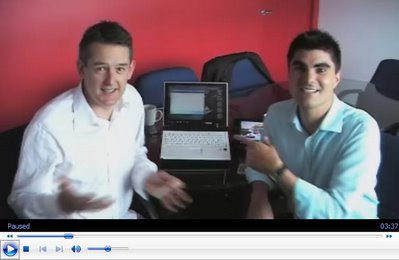 Jon has worked with Tom Cruise, Richard Branson, Kylie Minogue, and now he can add Hugo Ortega to the list! Well done Jon, youre a true ambassador.
Today turned out to be a blessing in disguise. What I had planned was a firsthand look at the brand new Toshiba R400 (don’t panic, I did that) but what ended up happening was rather special. Jon Dee, Founder of Planet Ark and Australian Spokesman for Al Gores “an inconvenient truth” DVD, is a real gentleman and more than that he’s a geek like us. As the ultimate envangelist for all things ecological and Green Jon can frequently be spotted driving his Toyota Prius, planting trees, or living it up in his “solar powered” home!
What I didn’t realize is that Jon has been a long time fan of the UberTablet blog, and more importantly, of Microsoft’s Tablet PC. So at first when he made contact and offered me a look at the new R400 (as seen on Engadget) I didn’t actually believe he had one, until I got there that is! Jon’s primary intention with tablet PC is to become, and BE, paperless in every way humanly possible; and after watching this video I’m sure you’ll agree he’s doing a bloody good job of it.
So sit back with your favourite beverage and watch as one of the Globe’s premiere environmentalists talks through his experience as one of the first owners of a Toshiba R400. He’s already owned it for two weeks, which ironically, when calculated backwards, is about a day after its CES 2007 launch. (To not let Jon take all the glory you’ll note the diminutive little device I tout – after seeing the R400 I now call it the once famous Q1)
Watch the Video [Hi Res, 150MB] click here
Download the Video [Hi Res, 150 MB] right click here "Save Target As"
Watch the Video [Low Res, 48MB] click here
Download the Video [Low Res, 48 MB)] right click here "Save Target As"
Todays Gallery


Always Searching for the Next Big Feature
Monday, January 19, 2015

Now that more than a handful of new tablets have hit the market in 2010, the shift in talk has turned from X vs. Y discussions about which tablet is better (usually with the iPad involved somehow) toward how the next generation of these devices will stack up against their current iterations.
We all know the iPad is a runaway success, despite it’s less than ideal standards. The Galaxy Tab is also turning out impressive numbers, especially in the US where it has sold more than 1 million units as of a couple days ago. Other devices like the Dell Inspiron Duo, HP Slate and Viewsonic G are all hitting the market before the holidays and more are prepping for release early next year.
But, you know as well as I do that when it comes to technology, the hype for a new device only lasts as long as it’s unavailable. After release and a few weeks of sales tracking, the talk turns to when the next version of that device will be available and how much it will add to blow away all previous models.
Of course, most of the conversations right now seem to focus on what Apple will do to compete with the onslaught of competitors. Sure, Apple has sold more than 4 million iPads, but how will they maintain that industry lead in the iPad 2? Not much is known (other than the highly rumoured camera and a probable processor upgrade), but I’m sure we’ll see more of the same halo-device style upgrades that Apple is known for.
But, what about the rest? What major features are on the horizon in this industry that smaller companies are willing to experiment with in a bid to carve out a share of this market? In 2010, we saw the release of a dual-boot Windows 7 and Android tablet in the Tega V2, something that changed how many people think about the functionality of a tablet PC. The Dell Inspiron Duo is offering a dual mode netbook/tablet experience for those that still feel the urge to type on occasion – definitely not a new idea in touch technology, but a welcome one in the current tablet arms race.
In 2011, Acer has announced its 10 inch and 7 inch tablets with dual core processing, front and back facing cameras (a feature I think we’ll see serious traction on), HDMI out, and multiple form factors (as Samsung has discovered, not everyone wants a 10-inch tablet). Other devices are touting potential phone service, and the first wave of 4G enabled tablets is likely to start popping up by the end of 2011 with most major network upgrades starting to go into effect.
What do you think? What major upgrades and technology introductions do you think will drive the tablet industry in the next 6-12 months? Will we actually see game changing set of features from the iPad, or more of the same closed off iOS environment we’ve grown used to? And will devices with bigger and better features get a foothold in the industry any time soon?
Subscribe to:
Posts (Atom)
